
DUBAI, UAE – March 24, 2026 – Dubai’s real estate sector has surged into 2026 with record-breaking momentum, transitioning from a period of rapid acceleration into a sophisticated, value-driven “maturity phase.” Despite global economic shifts, the market continues to attract significant international capital, anchored by robust fundamentals and a historic start to the year.
Market Performance: A Tale of Two Sectors
The first quarter of 2026 has been characterized by a clear distinction between the booming primary (off-plan) market and a resilient, stable secondary market.
-
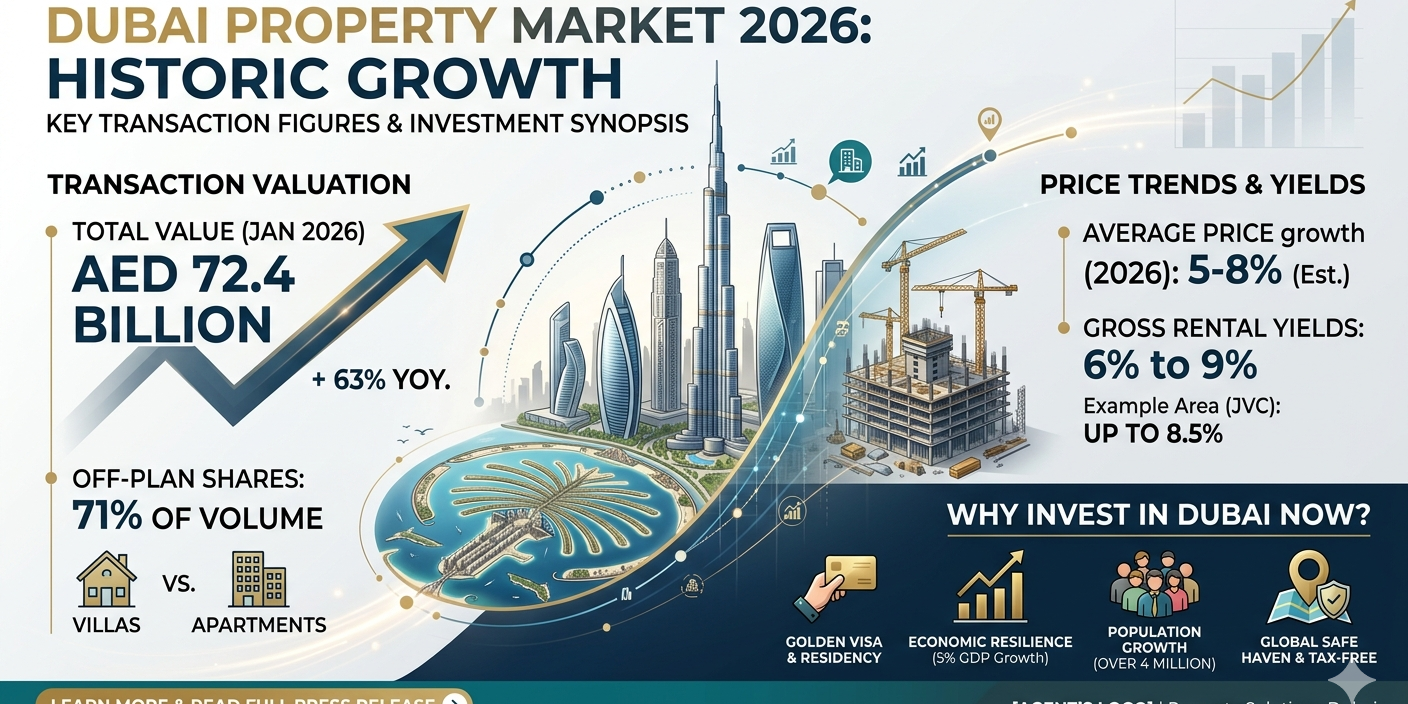
Total Transaction Value: January 2026 alone recorded a staggering AED 72.4 billion in sales—the highest monthly total in the emirate’s history—representing a 63% year-on-year (YoY) increase.
-
Off-Plan Dominance: The primary market remains the primary engine of growth. Off-plan sales accounted for approximately 71% of total transaction volume in early 2026. Buyers are increasingly drawn to flexible 60/40 or 1% monthly payment plans, with off-plan apartment prices averaging AED 2,109 per sq. ft.
-
Secondary Market Resilience: While transaction volumes in the secondary market saw a marginal dip of 1%, the total value increased by 38% YoY. This indicates that buyers are shifting toward higher-value, ready-to-move assets. Ready villas, in particular, are commanding a premium, averaging AED 2,025 per sq. ft. due to limited supply in established communities.
Current Price Trends & Yields
The market is currently undergoing a “healthy stabilization,” with price growth moderating to a sustainable 5% to 8% forecast for the year.
-
Rental Yields: Dubai continues to outperform global peers like London and New York. Average gross rental yields remain highly attractive at 6% to 9%, with mid-market hubs like Jumeirah Village Circle (JVC) seeing yields as high as 8.5%.
-
Luxury Sector: The ultra-luxury segment remains a global outlier. In January 2026 alone, nearly 990 homes priced above AED 10 million were sold, driven by a continued influx of high-net-worth individuals (HNWIs).
Why Dubai Remains the Premier Investment Choice in 2026
Industry analysts point to five core pillars that sustain Dubai’s “Safe Haven” status:
-
Economic Resilience: With a projected GDP growth of 5% in 2026, Dubai’s economy is diversified across tourism, logistics, and technology, reducing reliance on any single sector.
-
Population Influx: Dubai’s population is crossing the 4 million mark, creating a constant demand for both housing and infrastructure.
-
Investor-Friendly Policy: The Golden Visa program remains a major draw, providing long-term residency for property investors. This is bolstered by a tax-free environment—no property, capital gains, or inheritance taxes.
-
Regulatory Transparency: Enhanced escrow laws and the Dubai Land Department’s (DLD) digital transformation have made Dubai the most transparent real estate market in the MENA region.
-
Quality of Life: Rank among the safest cities globally, Dubai’s “D33” economic agenda continues to pour billions into urban wellness, green spaces, and world-class connectivity.
Synopsis: A Strategic Window for Investors
While the market is seeing a massive wave of new supply—with roughly 42,000 to 45,000 units expected this year—this is viewed by experts as a necessary “market normalization” rather than a downturn. For investors, this creates a unique window: a wider choice of high-quality inventory, more competitive developer incentives, and the opportunity to lock in high yields before the next cycle of appreciation.
Receive expert information on the best places to invest for high rental returns and high capital appreciation from Simon Mobley our Dubai Expert.